June 4-5th, 2026

Agorà Building (U6), Aula Magna

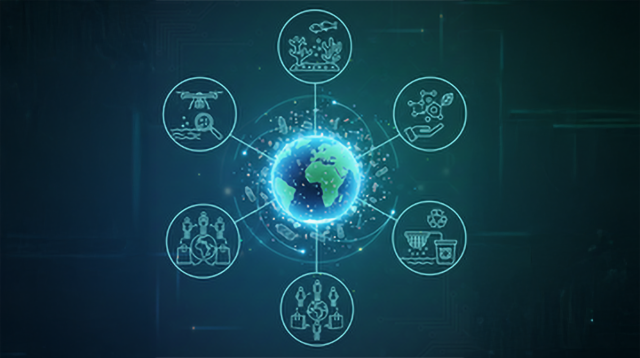
Exploring environmental, sustainability and planetary health dimensions
The 3rd edition of the interdisciplinary conference “Plastics & Environment”, organised by the University of Milano Bicocca, Research Centre POLARIS (Environmental Health and Sustainability), builds on the previous workshops held in Ravenna by the University of Bologna.
It brings together experts to address key challenges related to environmental and socio-economic sustainability as well as the health implications of the “plastic world”. By involving scientists from several disciplines, covering chemical, biological, physical, social and economic sciences, the conference will explore the fields of monitoring and characterisation of micro- and nanoplastics, their effects on ecosystems and human health, socio-cultural and educational strategies toward zero waste, the development of safe and sustainable materials, as well as degradation and mitigation approaches within the circular economy and bioeconomy frameworks.
The final goal is to provide an update on the frontiers in the different research areas, while also promoting cross-fertilisation among the scientific disciplines to better manage the innovation and sustainability dimensions.
WORKSHOP OPENING (Free event open to all)
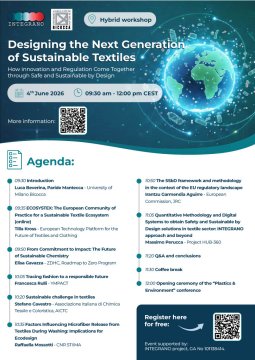
DESIGNING THE NEXT GENERATION OF SUSTAINABLE TEXTILES
How innovation and regulation come together through Safe and Sustainable by Design
June 4th, 2026
Time 9:30-11-30

Streaming a questo link

This event is the inaugural workshop opening the “Plastics & Environment” conference at the University of Milano-Bicocca.
The program features keynote speeches and expert contributions from representatives of textile associations, industry leaders, and innovators engaged in European and national initiatives to promote sustainable textiles. Bringing together diverse stakeholders from across the textile value chain, the workshop aims to foster dialogue between research, industry, policy and society.
The primary objective is to provide a comprehensive overview of the current state of the textile sector and to explore its future developments, with particular emphasis on environmental and socio-economic sustainability coupled with technological innovation.
Event supported by: EU project INTEGRANO, AICTC.
CONFERENCE TOPICS
Micro- and nano-plastics are quite ubiquitous in the environment. What makes “the difference” is the quantity present in each environmental compartment and the features that micro- and nano-plastics have therein. Quantity, size, shape, chemical composition and color are parameters both used for micro- and nano-plastics characterization and impact assessment on health and environment, as well as the target of the environmental monitoring. In this respect, a plethora of sampling techniques and analytical methods exists for their quantification. This section is devoted both to the environmental data description inter- and intra-environment processes involving plastics, and to the methodological protocols adopted as well as intercomparisons among them.
Plastics are now pervasive across environments, yet their ecological and ecotoxicological impacts remain poorly resolved. This session addresses plastics and their additives as contaminants, focusing on ecotoxicological effects, underlying mechanisms of action across biological levels, and consequences for broader ecological processes and ecosystem functioning. Studies on the mechanisms of controlled environmental degradation of micro and nanoplastic (MNP) pollution are also considered. We welcome contributions from diverse environments and disciplines to identify commonalities and differences that can advance understanding of plastic impacts and remediation strategies
Micro and nano plastics (MNPs) are ubiquitous materials and exposure to humans occurs through different routes, such as ingestion and inhalation. Adverse effects on primary target tissues and distal ones is likely. The session aims at bringing together latest knowledge on the impact of MNPs on relevant human barriers and other secondary target tissues, with emphasis also on the relationship with realistic exposure to these ubiquitous pollutants. Starting from lessons from pharmacology and in accordance with the 3R principles, integration of in vitro and in vivo methodologies, as well as researches on new approach methodologies (NAMS), contributing to MNPs risk assessment, will be considered relevant in this session.
Advanced safe and circular (bio) polymers represent a paradigm shift in materials science, moving beyond the linear 'take-make-dispose' model toward closed-loop ecosystems. Central to promote the innovation and market in this field is the EU strategy for Safe and Sustainable Chemicals and Materials, declined into the Safe and Sustainable by Design (SSbD) framework and guidelines. Researches on new sustainable materials and processes, including the valorization of bio-based feedstocks, molecular self-healing, and programmed biodegradability are welcome. Also considering the mitigation and remediation technologies, this session has the ambition to present how integrating different dimensions, including physical and chemical sciences, biotechnology, toxicology, economic and social impacts, in a LCA perspective, it is possible to design innovative sustainable materials and promote a circular (bio)economy.
The session examines the socio-economic, political and cultural dimensions of urban environmental transitions, focusing on how practices, infrastructures, public policies and governance systems shape pathways toward plastic-free, circular and carbon-neutral cities. Plastic is framed as a core element of urban socio-technical systems, embedded in everyday practices, institutional arrangements and power relations. The session highlights participation, education and public engagement, as well as environmental justice and inequality, approaching cities as laboratories of socio-ecological innovation and collective transformation toward more sustainable urban futures.
SCIENTIFIC COMMITTEE
- Sergio Andò, Monica Bernardi, Paola Branduardi, Matteo Colleoni, Maddalena Collini, Luca Ferrero, Maurizio Gualtieri, Paride Mantecca, Veronica Nava, Francesco Saliu, Giulio Sancini, Immacolata Serra (University of Milano - Bicocca)
- Elena Fabbri, Andrea Facchin, Paola Galletti, Alessandra Landi, Chiara Samorì, Paola Valbonesi (University of Bologna)
- Lavinia Casati, Marco Parolini (University of Milano)
- Paolo Bigini (Istituto di Ricerca Farmacologiche Mario Negri IRCSS)
- Arto Hiltunen (University of Turku, Finland)
- Lang Tran (Institute of Occupational Medicine, Edinburgh, Scotland)
- Margit Heinlaan (National Institute of Chemical Physics and Biophysics, Tallin, Estonia)
- Piotr Markuszewski (Institute of Oceanology, Polish Academy of Sciences, Sopot, Poland)
ORGANIZING COMMITTEE
Rossella Bengalli, Monica Bernardi, Paola Branduardi, Maddalena Collini, Mariaclaudia Cusumano, Maurizio Gualtieri, Alessandra Lama, Paride Mantecca, Valeria Mapelli, Riccardo Milanesi, Giulio Sancini, Giulia Terribile.
REGISTRATION
By May 18, 2026
For more info please contact [email protected]
Pictures from the congress


